
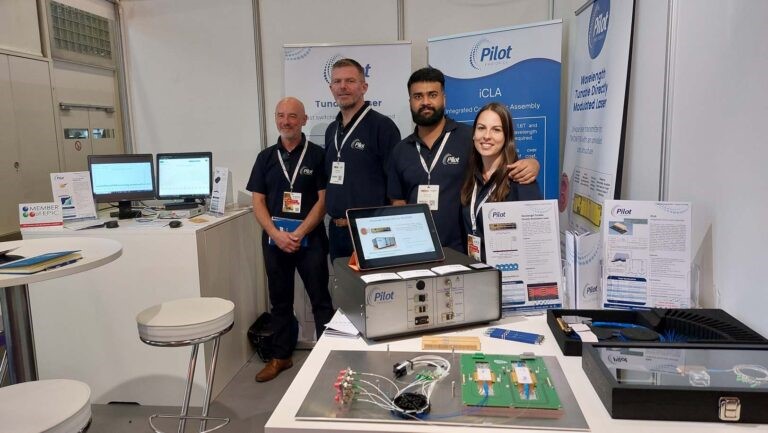
January 1, 2023 Image: Pilot Photonics team at ECOC 2022. From left to right: Damian McGillivary...
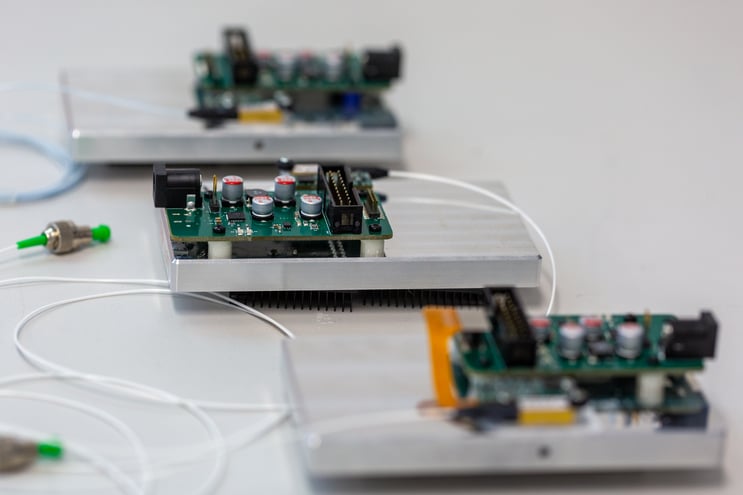
We recently wrapped up a couple of upscaling projects as we prepare our products for larger scale production. This is how we are preparing for volume!
No matter the application, market, or the technology, every startup with a physical product reaches the same make or break stage: can the product scale?
In our case, Pilot Photonics is leveraging the scalability of photonic chips to make optical solutions smaller, cheaper, and more power efficient. Still, photonic integrated circuit (PIC) devices go through many iterations in circuit design, process engineering, assembly optimisation, packaging approaches, and control algorithms. Projects like PhotonHub Europe, funded by the European Commission through the Horizon Europe programme, are designed to support product developers like Pilot through those development stages.
We have just wrapped up a couple of scale-up projects to improve the Technology Readiness Levels (TRL) of two of our products. Our integrated comb laser assembly (iCLA) and our nano-integrated tuneable laser assembly (nano-iTLA), both based on monolithic indium phosphide PICs, have reached new levels of manufacturability thanks to our collaborations with Fraunhofer HHI and SMART Photonics.
CLASSYCAL: Comb lasers for millimetre-wave generation
The integrated comb laser assembly (iCLA) was initially designed for scaling coherent optical transceivers by delivering multiple coherent wavelengths from a single laser. As we continued developing it, it has received significant interest also for micro-wave and mmWave applications in space, test and measurement, and mobile telecommunications.
Project CLASSYCAL was conducted in collaboration with Fraunhofer HHI. The goals of the project were deeper integration and miniaturisation, improved electronics, and better monitoring and control. This included the integration of high speed photodetectors, developed by HHI, for ultra-high speed operation, packaging refinements for improving the thermal performance and deeper integration for manufacturability.
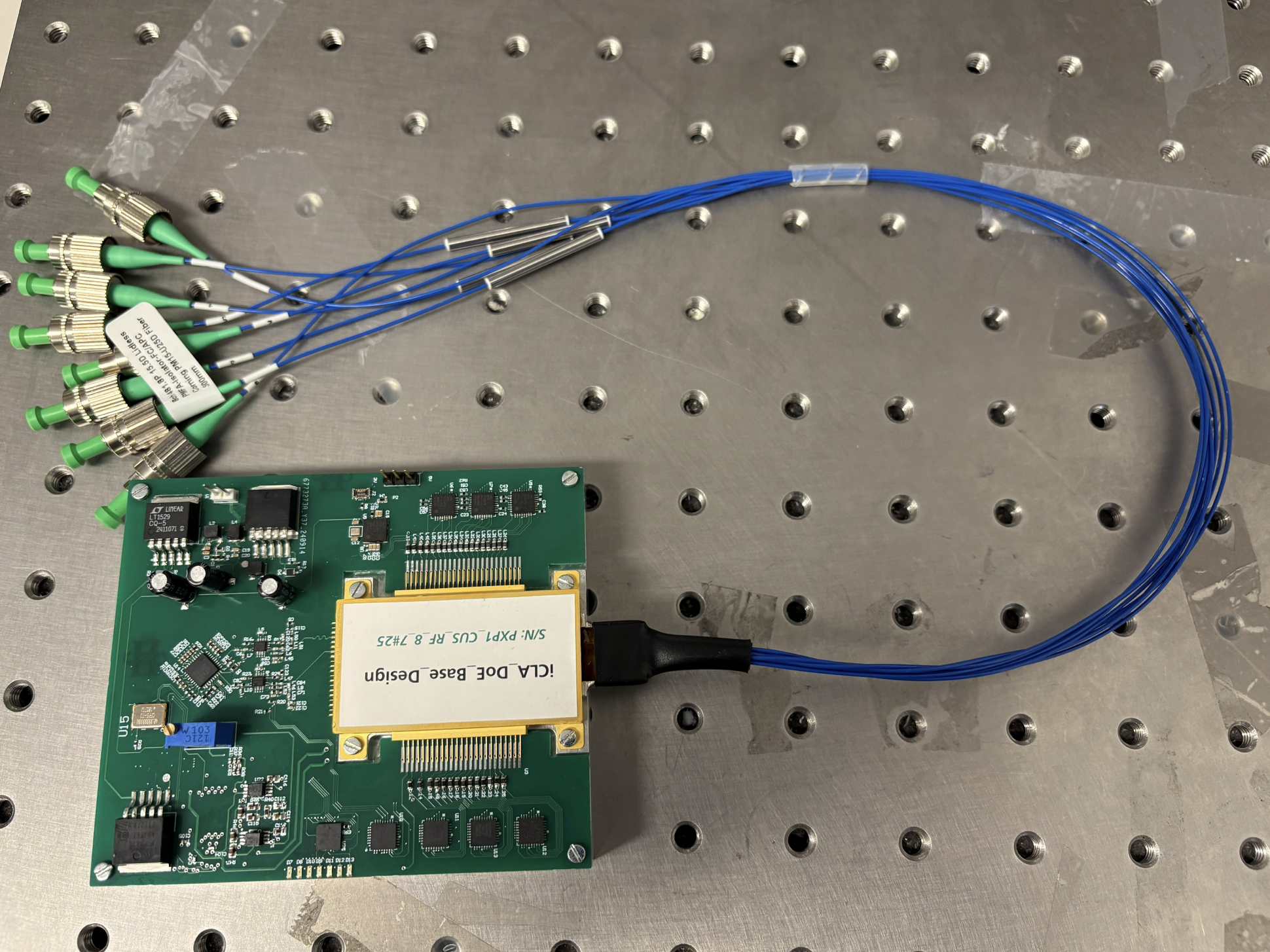
Embedded iCLA module produced during project CLASSYCAL
We also improved the device’s post production phase. Burn-in protocols were developed to improve its stability. Along with that, we developed closed loop control algorithms, enabling customer field testing. This fed into an early evaluation unit for a variable optical frequency generator unit (OFGU), which we recently published a white paper on.
We’re now at a stage where the new miniaturized form-factor is enabling more customer demonstrations and customer feedback is mapping the road ahead for the device development. The next phase will be a design for manufacture with a view to ramping up.
NETTLESOUP: Tuneable lasers for high speed operation
Our nano-integrated tuneable laser assembly (nano-iTLA) is geared towards optical communications, test & measurement, LiDAR, and coherent optical inter-satellite links. Its high speed tuneability in the nanosecond regime has received a lot of interest from AI data network innovators like Finchetto and satellite communication builders like MBRYONICS.
There is continuous pull in our target markets for increased laser output power. This was one of our objectives in NETTLESOUP, along with improving yield, and manufacturability in pilot production runs. In collaboration with SMART Photonics, these targets were achieved.
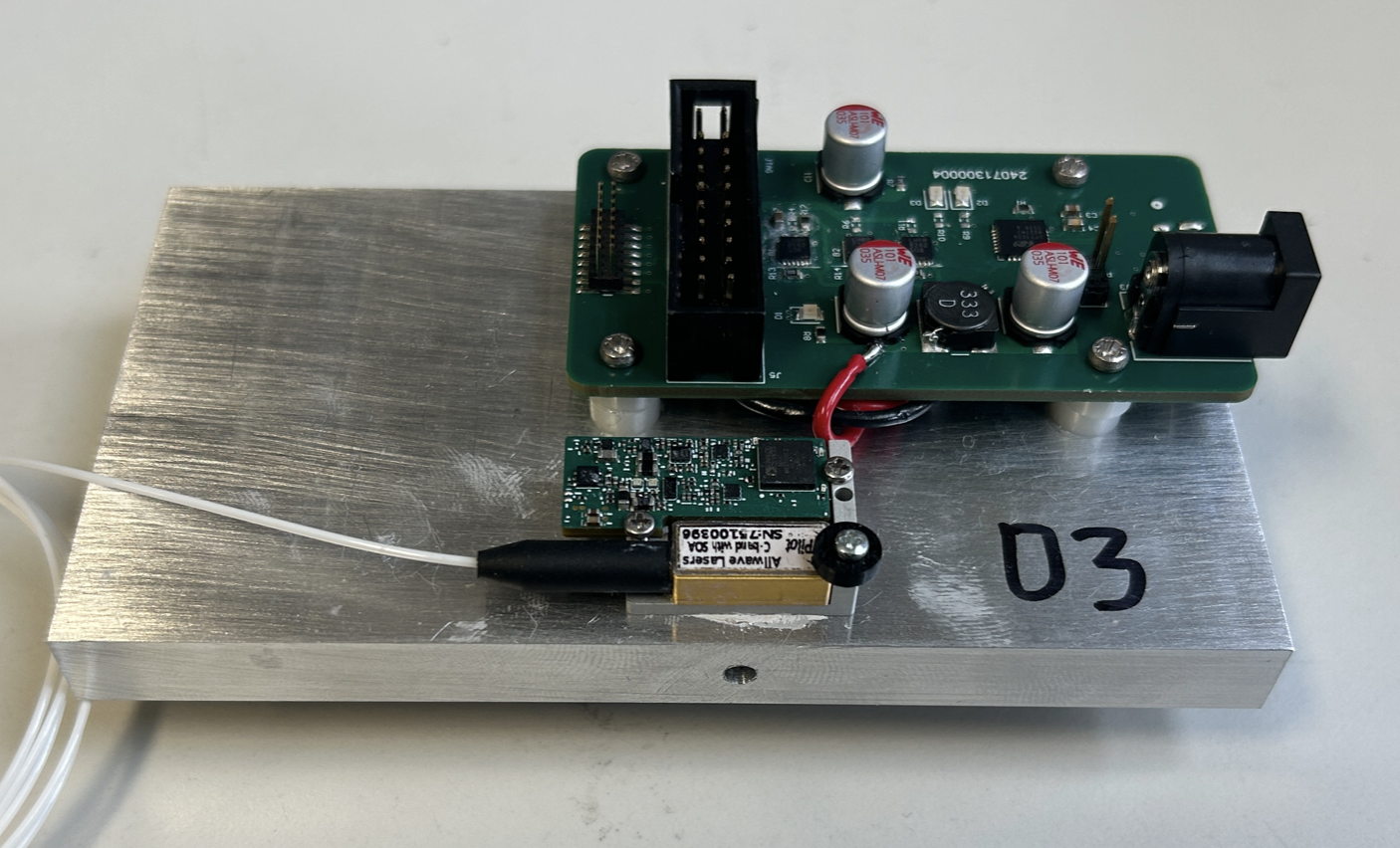
Nano-iTLA module produced during NETTLESOUP, with goldbox laser packaging and wrap-around electronics.
On the manufacturability front, we tested out the use of tapered semiconductor optical amplifiers (SOA) to reduce gain saturation and avoid complicated processing, relying on SMART’s improved 4 inch process. Production was streamlined across the board, from mask creation to back-end processing with new benchmarks in time from tape-out to fab-out. With the monolithic integration of the SOAs and the testing out of design variations, we were able to achieve target power, and have seen 18 dBm ex-facet consistently. The tapered SOA also allowed extra feedback resilience, and design variations have made it clear that increasing the tuning range is also possible.
What comes next for our integrated lasers
Signals from the market have been consistently positive regarding our nano-iTLAs. This is why our primary occupation is making sure that our products can be repeatably manufactured in volume with the performance, yield and reliability demanded by our customers.
We are producing and delivering evaluation and design-in modules and taking in all the feedback we’re getting. It is plenty of work for our small team, which is also why we are stoked about the funding we recently received via the European Innovation Council. We are planning on growing locally and internationally, and will accelerate our product work with every new colleague.
Getting Pilot Photonics to this stage has taken a lot of work, funding, and building trust. Programmes like PhotonHub are instrumental in stimulating the European ecosystem, enabling small companies to bring innovative deep tech products to various markets. We are very proud of the progress we have been making, and look forward to sharing more project results with you in the near future!