
To celebrate the completion of validation testing for our space microcombs, we have put together an overview of our project with the European Space Agency, Miniaturised Frequency Comb for Science Mission Applications (MiCoSMic), and our ongoing development of a two comb optical system for space science.
Why space science satellites can use optical combs
Space science depends on precise, efficient instrumentation engineered for use under specific environmental constraints. High-resolution spectrometers are essential for broadening the range of astrophysical objects from which data can be obtained. To identify chemical signatures, star systems, and exoplanets, these spectrometers must maintain high accuracy. Achieving and raising this level of accuracy is an ongoing challenge for space tech. The ideal calibration sources for spectrometers should provide a high density of bright, regularly spaced optical lines. They should have a broad bandwidth coverage and be ultra-stable. Gas emission lamps, the industry standard, suffer from long-term instability and irregularly-spaced spectral lines.
An alternative is to use an optical frequency comb as the calibration source. Optical frequency combs consist of a series of equally spaced mutually coherent wavelengths of light, often referred to as comb lines. Comb sources provide the characteristics required for in-flight recalibration and monitoring, but so far they have been too bulky and too power hungry to fly on board. Miniature and efficient optical combs are a promising alternative.
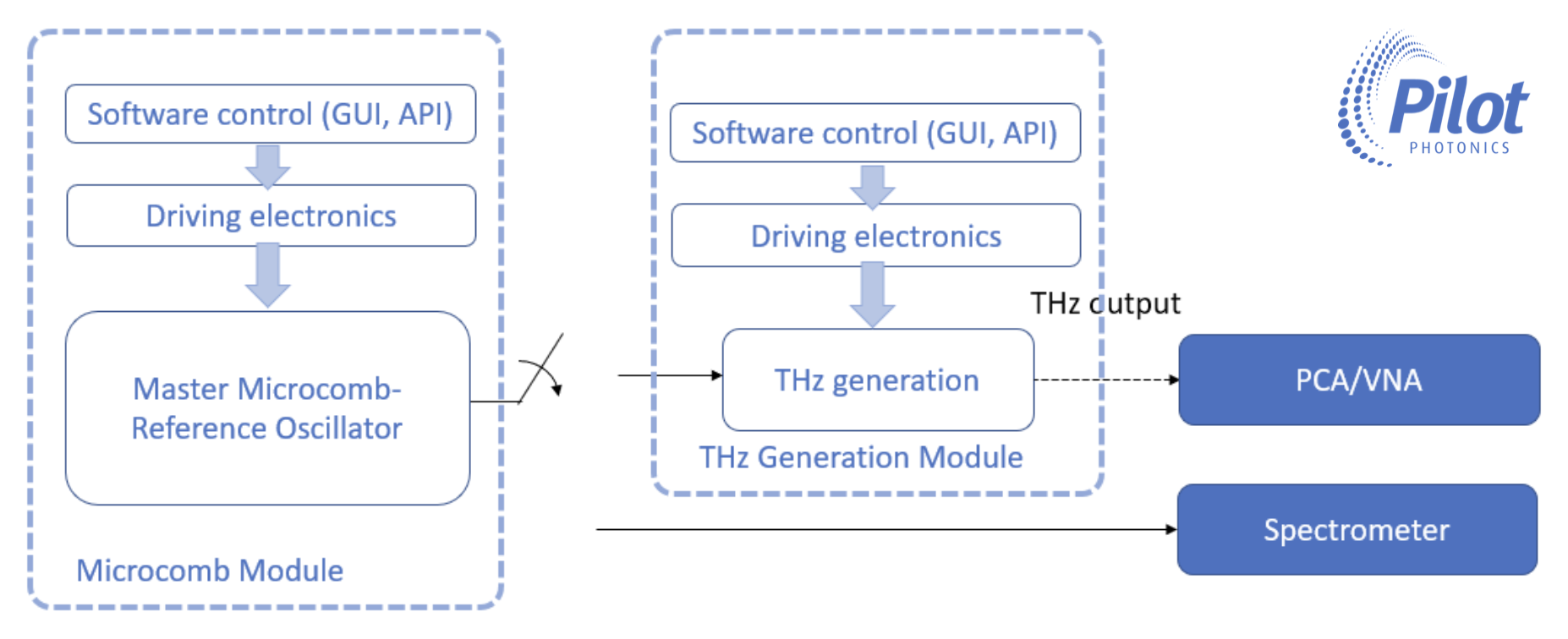 System schematics of where integrated optical frequency combs can enhance space science instrumentation.
When performing measurements in the terahertz region of the electromagnetic spectrum, heterodyne detection techniques are often the only practical approach. These frequencies lie beyond the bandwidth of conventional direct-detection systems, making it difficult to observe the weak signals emitted by sources such as the interstellar medium. Heterodyne detection requires a local oscillator, which is a stable reference signal that helps measure incoming radiation. By mixing the two together, the high-frequency signal is shifted down to a lower frequency, where it can be easily measured using standard electronics. Oftentimes, local oscillators consist of a complex chain of electronic frequency multipliers and amplifiers that are cascaded in order to generate the required carriers.
Again, optical comb sources offer an alternative technological solution. Suitable carriers can be generated through the optical heterodyning of two comb lines from an optical frequency comb, producing a signal at their frequency difference. The spacing between these comb lines, known as the free spectral range (FSR), determines the range of frequencies that can be generated in this way, and can vary from GHz in gain-switched combs to THz in dissipative Kerr soliton (DKS) combs, depending on the comb generation mechanism and device design. Both comb technologies can be implemented using photonic integrated circuits (PICs), enabling compact and scalable solutions that offer significant reductions in size, weight, power, and cost (SWaP-C).
How our photonic chips make for innovative optical combs
In MiCoSMic, we are utilising two different comb technologies to develop hardware that can meet the demands of these two application areas. The first is a DKS comb, generated through the high power optical pumping of a silicon nitride micro-ring resonator. This comb platform allows for the generation broadband frequency combs, with beyond an octave of spectral coverage possible. Within MiCoSMic, the FSR of our microcomb is 383 GHz, with this dependent on the physical geometry of the micro-ring resonator itself. The broad spectral coverage and equally spaced comb lines make this comb technology the ideal candidate for use as a calibration source for optical spectrometers, replacing the need to use multiple gas emission lamps to achieve the same coverage. A standalone microcomb module has been developed, and was tested as part of the spectrometer calibration application validation tests.
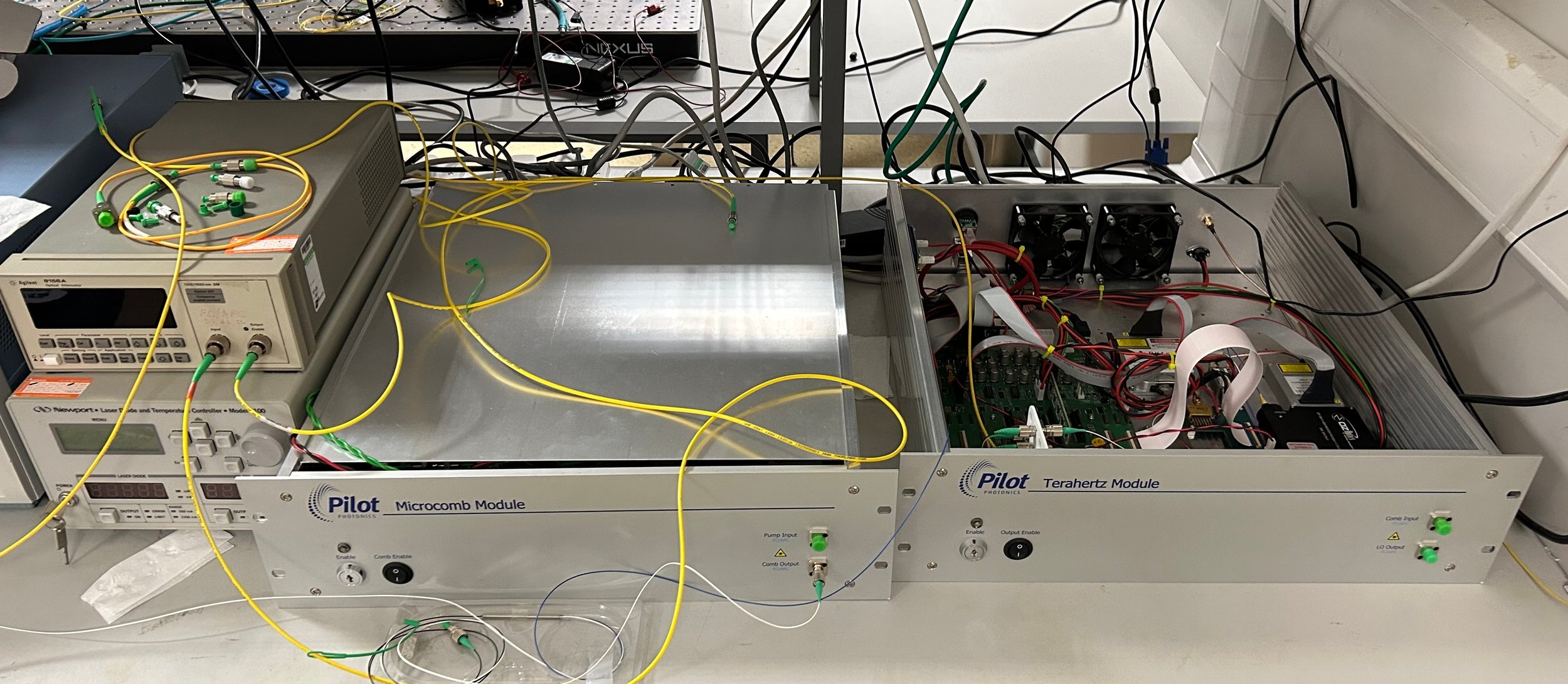 Optical microcombs in early testing at Pilot.
Gain-switched optical frequency combs, the second comb technology utilised within MiCoSMic, provide complimentary trade-offs to DKS. Generated through the direct modulation of the DC bias of a semiconductor laser around its threshold using a high power RF signal, gain-switched combs provide a more flexible comb than our DKS comb. The frequency of the RF signal used for gain-switching determines the FSR of the comb, allowing for a high degree of tunability and accuracy when selecting the comb line spacing. However, the spectral bandwidth of these combs is more limited, usually only covering a number of nanometres. Within this project, we demonstrate a hybrid optical frequency comb achieved by injection-locking a DKS comb and a gain-switched comb to offer attractive features of each comb; broad bandwidth from the DKS comb, and precise flexible frequency operation from the gain-switched comb. The terahertz frequency carriers, suitable for use as local oscillators, are generated via optical heterodyning. Optical heterodyning mixes two optical signals on a fast photodiode to produce an electrical signal equal to their frequency difference. The mutual phase coherence between comb lines results in carriers with reduced RF linewidth, and improved frequency stability and phase performance compared to carriers generated from independent laser sources. An additional Terahertz Module has been developed to support the generation of the gain-switched comb. Both the Microcomb Module and the Terahertz Module will be tested in unison to generate carriers in the 0.6 – 1 THz range.
Together, these approaches highlight the versatility of optical frequency combs, combining broad spectral coverage, high stability, and flexible operation. By leveraging the complementary strengths of different comb technologies, MiCoSMic demonstrates a pathway towards compact, high performance sources capable of meeting the demanding requirements of both spectrometer calibration and terahertz heterodyne detection. Furthermore, the integration of these technologies onto photonic integrated circuits (PICs) offers a clear route towards significant SWaP reductions, enabling more compact, efficient, and scalable solutions for future space and sensing applications.


Validation testing of the modules at Maynooth University (left) and the Royal Belgian Institute for Space Aeronomy (right).
See you at ICSO?
Following design, manufacture and preliminary functionality testing, the modules have now finished testing with our validation partners in the project.
Royal Belgian Institute for Space Aeronomy (BIRA-IASB), based in Brussels, tested the optical frequency comb source as a calibration source for optical spectrometers in space missions. Those include wavelength scale and intensity stability, accuracy and reproducibility.
Our partners at Maynooth University tested terahertz carrier generation in the 750 GHz to 1 THz frequency range. These tests verify the combs’ readiness for use as a local oscillator in space heterodyne instrumentation. Terahertz carrier accuracy and stability are of specific interest.
With the testing now complete, the project is wrapping up and results are being collated. At the International Conference of Space Optics this year, we will be sharing the results of the validation and testing. We are looking forward to it, and further, to going fully cosmic with our light sources!